
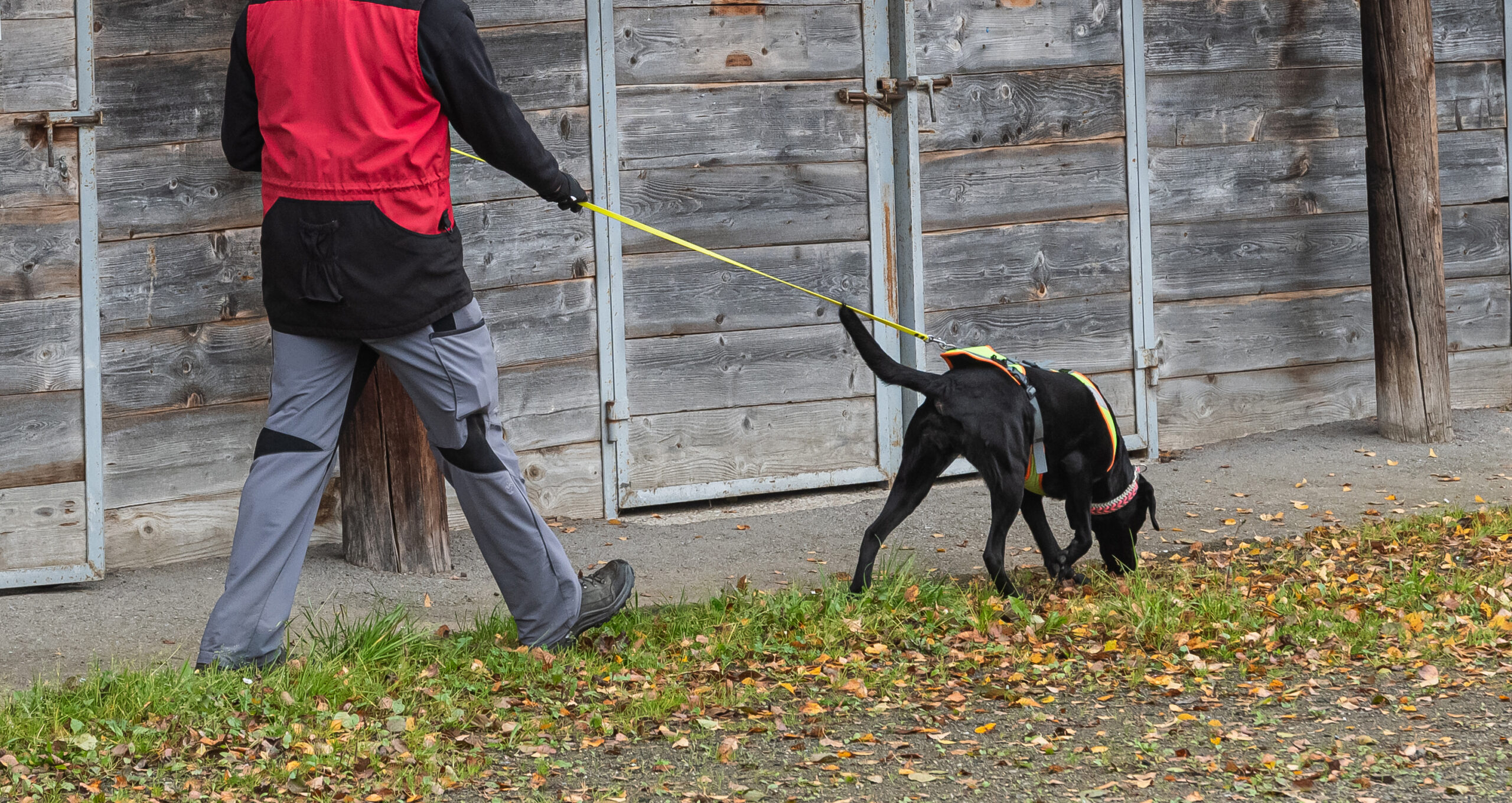
Tracktrailing is a fascinating and varied activity that challenges, supports, and connects both dog and handler. It’s not only the dog’s scent work that takes center stage, but also the trustful collaboration within the team. Working together, tuning into each other, and learning from one another is what makes this activity truly special.
Tracktrailing is a fascinating and engaging activity that challenges, supports, and connects both dog and handler. It’s not only the dog’s scent work that takes center stage, but also the trustful collaboration within the team. Working together, discovering how much you can learn from each other and sharing a joyfull journey is, what makes this activity truly special.
The self-check serves as a guide to what you can expect on your Tracktrailing journey. Of course, neither handler nor dog are expected to meet all the criteria from the beginning, as growth and development are an essential part of the process.
Is Tracktrailing right for your dog?
Every dog naturally has excellent scenting abilities. Still, certain traits and behaviors can make it easier to get started and enhance long-term enjoyment in this versatile and rewarding activity. Below, there are some key traits that make a dog particularly well-suited for tracktrailing:
1. Joy in searching
Dogs that enjoy sniffing and playing scent games are ideally suited for Tracktrailing. They are usually easy to motivate for tasks that engage their noses. Their enthusiasm and willingness to work often come naturally through the way the exercises are structured. A genuine joy for searching allows them to focus intensely on the task and maintain their attention over longer periods.
2. Persistence and focus
Tracktrailing is an exciting and versatile activity that helps dogs develop persistence and focus. Dogs that are calm and focused during longer scent games often achieve rapid learning success. Even dogs that may initially seem impatient or a bit energetic can gradually learn to work systematically and thoroughly—through patience, practice, and the right guidance, every dog can grow into this rewarding and challenging activity.
3. Fitness and health
Intensively searching an area for a target scent (as in scent dog training) or following a “scent trail” over long distances (as in human search work) can be physically demanding, as the dog must adapt to various challenges along the way. A healthy, fit dog is an important factor for a successful and enduring search. At the same time, it is crucial to understand your dog’s limits to avoid overexertion and provide training that is both enjoyable and rewarding. Tracktrailing is highly adaptable to individual needs and can be practiced in many ways even with physical limitations, as long as personal goals and training steps are appropriately adjusted.
4. Keen nose and natural search instinct
Dogs are naturally curious about different scents. Their ability to detect even the faintest traces and follow them is a key factor for a successful search, making the shared work between dog and handler particularly exciting and rewarding. Does your dog show a strong interest in sniffing out scents in their environment? Do they enjoy following trails in everyday life? Do they like searching for scattered treats or hidden toys? Wonderful – if so, you can be confident that your dog will also bring enthusiasm and motivation to Tracktrailing.
Is Tracktrailing right for you?
Humans also play a key role in tracktrailing. To be a successful teammate, certain qualities are important:
1. Time and pleasure in collaborating with the dog
Tracktrailing is not a task for the dog alone – it is true teamwork. If you enjoy tackling small challenges regularly together with your dog and want to actively strengthen your bond, this discipline is likely to be a perfect fit for you. The great thing about it is that training success is developed step by step, like a puzzle, which is why it fits so easily into a busy everyday life. Training sessions can be done independently, and many elements can be practiced at home or on short, routine walks.
2. Motivation to learn and persistence
The path to becoming a Tracktrailing professional usually takes several months, but you will gain a training concept that provides enjoyment, mental stimulation, and shared experiences for a lifetime—and, with a bit of creativity, never becomes boring. If you are ready to spend valuable time with your dog engaging in exciting scent work, you will find great joy in this unique form of working together. The training concept includes many highly natural, yet sometimes complex elements that are learned gradually through a structured process. Like assembling a puzzle piece by piece, a wide range of individual skills is built and strengthened to ultimately achieve the demanding goal of a focused search together, even under varying conditions. Are you ready, as a team partner, to learn how to closely observe your dog, improve your own handling and timing, and deal with training challenges in a fair and reflective way?
If you are willing to practice regularly and learn from experience, you will become a wonderful partner for your dog in Tracktrailing—and your searches together will bring great
3. Patience and understanding
Mastering all the skills needed for track trailing is a fulfilling challenge for both dog and handler. As a team partner, it requires patience to guide your dog through learning and refining their abilities, to recognize their signals, and to interpret them correctly. Patience is crucial: it helps you understand how your dog responds to each learning step and how best to support them in order to successfully overcome training challenges together. Are you ready to avoid rushing your dog and to adjust your own expectations to match your dog’s progress?
4. Fitness level
Tracktrailing doesn’t require extreme physical fitness, but being sure-footed on different surfaces—forest paths, grass, pavement, and more—along with endurance and basic strength, is particularly useful, especially during human searches. Depending on your dog’s training level, you may cover long distances on foot, navigate challenging terrain, and work in varying weather conditions. Searches can also take place in urban environments, so it’s always important to ensure your dog can be safely controlled on a leash, keeping both your dog and others out of harm’s way. For the reasons mentioned, a certain level of physical fitness is important to support both your dog and yourself in this demanding work. If you are interested in the focus area of individual human search with your dog, you should enjoy searches that can cover several hundred meters. If this doesn’t suit your preferences, scent detection training in all its facets and scent memory exercises offer exciting alternatives.
5. Mental resilience and problem-solving ability
Tracktrailing can also present mental challenges. It requires the ability to remain calm, attentive, and focused, even when a situation is difficult or a solution isn’t immediately apparent. Those who think creatively, approach problems patiently, and stay focused on the shared goal with their dog will thrive in this activity and find it both rewarding and fulfilling. Are you ready to see challenges as opportunities and mistakes as chance
Conclusion
Track trailing is a challenging and fascinating activity that engages both dog and handler in many ways. Dogs that enjoy scent games, have a strong work drive, and possess endurance make ideal partners for this type of activity. Likewise, handlers who are eager to learn, enjoy teamwork, and embrace the training process are ideal companions. Through this harmonious collaboration, Tracktrailing can become an extremely rewarding and motivating pursuit, offering lasting benefits for the human-dog team throughout their life together. I look forward to the journey together!